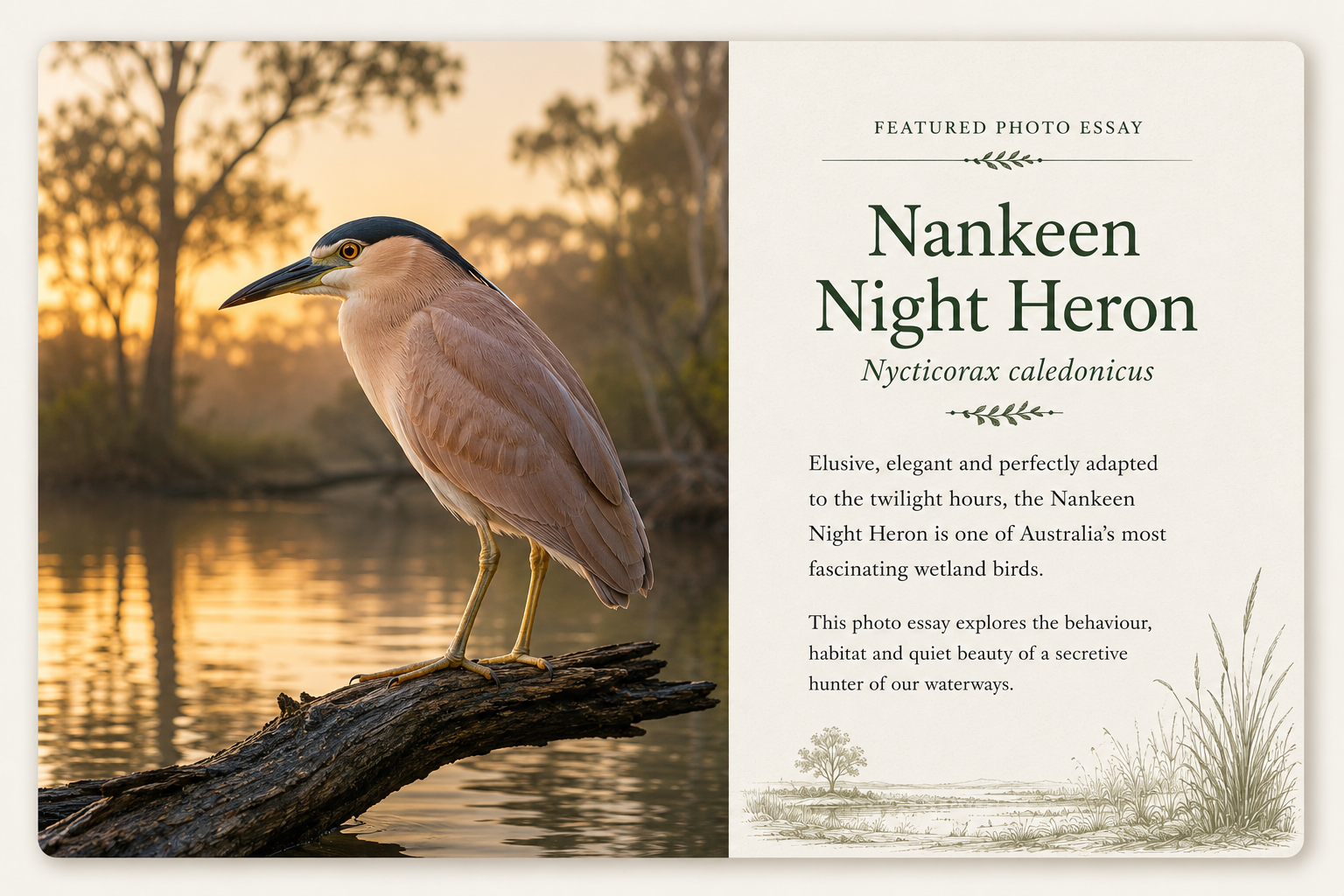
Some birds announce their arrival with brilliant colours or unmistakable calls. The Nankeen Night Heron does neither. It prefers silence, patience and the fading light of evening, appearing almost unnoticed until suddenly, there it is—a still figure standing at the water’s edge.
There is a special kind of excitement that comes from encountering a Nankeen Night Heron. Unlike many of Australia’s more familiar birds, this species rarely demands attention. It does not sing loudly from the treetops, gather in noisy flocks, or flash vibrant plumage across the landscape. Instead, it lives a quieter existence, hidden among reeds, overhanging branches and dense vegetation beside rivers, wetlands, creeks and mangroves. For many birdwatchers, a sighting feels like a reward earned through patience rather than luck.
As daylight fades and the bush settles into evening, the Nankeen Night Heron begins to stir. It emerges from its daytime roost with deliberate, almost graceful movements, stepping carefully through shallow water in search of fish, frogs, yabbies, freshwater crayfish, insects and other small prey. Every movement is measured. Every pause seems intentional. Watching one hunt is less like observing a bird and more like witnessing a master of patience.
A Bird of Twilight
The Nankeen Night Heron (Nycticorax caledonicus) is one of Australia’s most widespread herons, found throughout much of the mainland, Tasmania, New Guinea and many Pacific islands. Although widespread, it often goes unnoticed because of its secretive habits. Unlike White-faced Herons that patrol paddocks during the day, or Eastern Great Egrets that stand proudly in open wetlands, the Nankeen Night Heron prefers the softer light of dawn, dusk and night. During the day it often roosts motionless in dense trees overhanging water. Its rich chestnut back, cream underparts and dark crown blend perfectly with shaded branches, making it surprisingly difficult to spot. Many people unknowingly walk past one without ever realising it is there.

Built for Life After Sunset
Everything about the Nankeen Night Heron reflects its nocturnal lifestyle. Its large orange-red eyes gather the last remaining light as evening approaches. The strong dagger-like bill is perfectly adapted for seizing slippery prey, while its relatively short legs allow it to move quietly through shallow water without creating unnecessary disturbance. Rather than chasing fish, it waits. Sometimes for several minutes. The bird stands perfectly still, its gaze fixed on the water below. Then, in a movement so quick it is almost impossible to follow, the bill strikes with astonishing precision before returning to complete stillness. This patient hunting strategy conserves energy while maximising success.
The Art of Remaining Invisible
One of the greatest strengths of the Nankeen Night Heron is camouflage. The warm buff and chestnut tones of its feathers blend beautifully with river gums, fallen logs and drying reeds. At first glance it appears almost part of the landscape itself. Even when disturbed, the bird rarely flies immediately. Instead, it freezes. Its neck extends upward, its bill points skyward, and it becomes remarkably difficult to distinguish from surrounding branches and reeds. Only when danger becomes unavoidable does it launch into silent flight, disappearing effortlessly into the fading light.
A Hunter of Australia’s Waterways
Healthy waterways support healthy herons. These birds can be found in an incredible variety of habitats including: Quiet creeks, Billabongs, Farm dams, Freshwater wetlands, Mangrove forests, Estuaries, Floodplains, Urban lakes and parklands. Wherever shallow water meets shelter, there is the possibility of finding a Nankeen Night Heron. They often choose locations where overhanging vegetation provides both protection and an excellent vantage point from which to hunt.
Photographing a Nankeen Night Heron
Photographing this species requires patience rather than speed. Unlike fast-moving honeyeaters or fairywrens, the Night Heron rewards photographers who are willing to wait quietly.
Best Time
The hour before sunset and the first hour after sunrise provide the most beautiful light while matching the bird’s natural activity.
Move Slowly
Avoid sudden movement.The bird will often tolerate a quiet observer if approached carefully and respectfully.
Watch the Reflections
Still water creates beautiful mirror-like reflections that add elegance and atmosphere to photographs. Low angles can produce striking images where the bird and its reflection share the frame.
Tell the Story
Don’t always zoom in. Include surrounding reeds, reflections, river gums or fallen timber to capture the bird within its natural environment. These environmental portraits often become the most memorable photographs.
Behaviour Worth Watching
Although usually solitary, Nankeen Night Herons occasionally gather at productive feeding sites where fish are abundant. During breeding season they form colonies with other herons, ibises and egrets, building stick nests high in waterside trees. Both parents share incubation duties and care for their chicks, which hatch covered in soft down before gradually developing the rich colours of adulthood. Juvenile birds look remarkably different from adults. Rather than chestnut backs and pale underparts, young birds are heavily streaked with brown and white, providing excellent camouflage while they learn to hunt.
A Quiet Indicator of Healthy Wetlands
Wetlands are among Australia’s most important ecosystems. They filter water, reduce flooding, support countless insects, fish and amphibians, and provide homes for hundreds of bird species. The presence of Nankeen Night Herons often reflects a healthy wetland with abundant food and suitable shelter. Protecting these habitats benefits not only herons but turtles, frogs, dragonflies, fish, mammals and countless other species that depend upon clean water. Every restored wetland is another opportunity for this remarkable bird to thrive.
Field Notes
One of the joys of birdwatching is recording not only what you see, but how the experience made you feel. The first time I watched a Nankeen Night Heron, the sun had almost disappeared behind the river red gums. The creek was still, broken only by the occasional ripple of a feeding fish. At first I thought the bird was simply another weathered branch extending over the water. Only when it turned its head did I realise I was sharing the evening with one of Australia’s most elusive hunters. For several minutes it stood perfectly still. Then, without warning, it struck the water and emerged with a small fish clasped firmly in its bill. The entire movement lasted less than a second. Moments later the creek returned to silence, as though nothing had happened. Those are the moments that stay with you long after the photograph has been taken.
Final Reflections
The Nankeen Night Heron reminds us that nature does not always reveal itself immediately. Some of its greatest treasures belong to those willing to slow down, observe quietly and embrace the fading light. In a world that often celebrates speed and spectacle, this remarkable bird teaches a different lesson. It shows us the value of patience, stillness and careful observation. Perhaps that is why every encounter feels so memorable. Not because it is rare, but because it asks us to see the landscape differently—to notice the quiet corners of our wetlands, to appreciate the beauty hidden in the shadows, and to remember that some of Australia’s most extraordinary wildlife reveals itself only to those prepared to wait.
“The Nankeen Night Heron is not simply a bird of the night—it is a reminder that nature’s greatest moments often arrive in silence.”