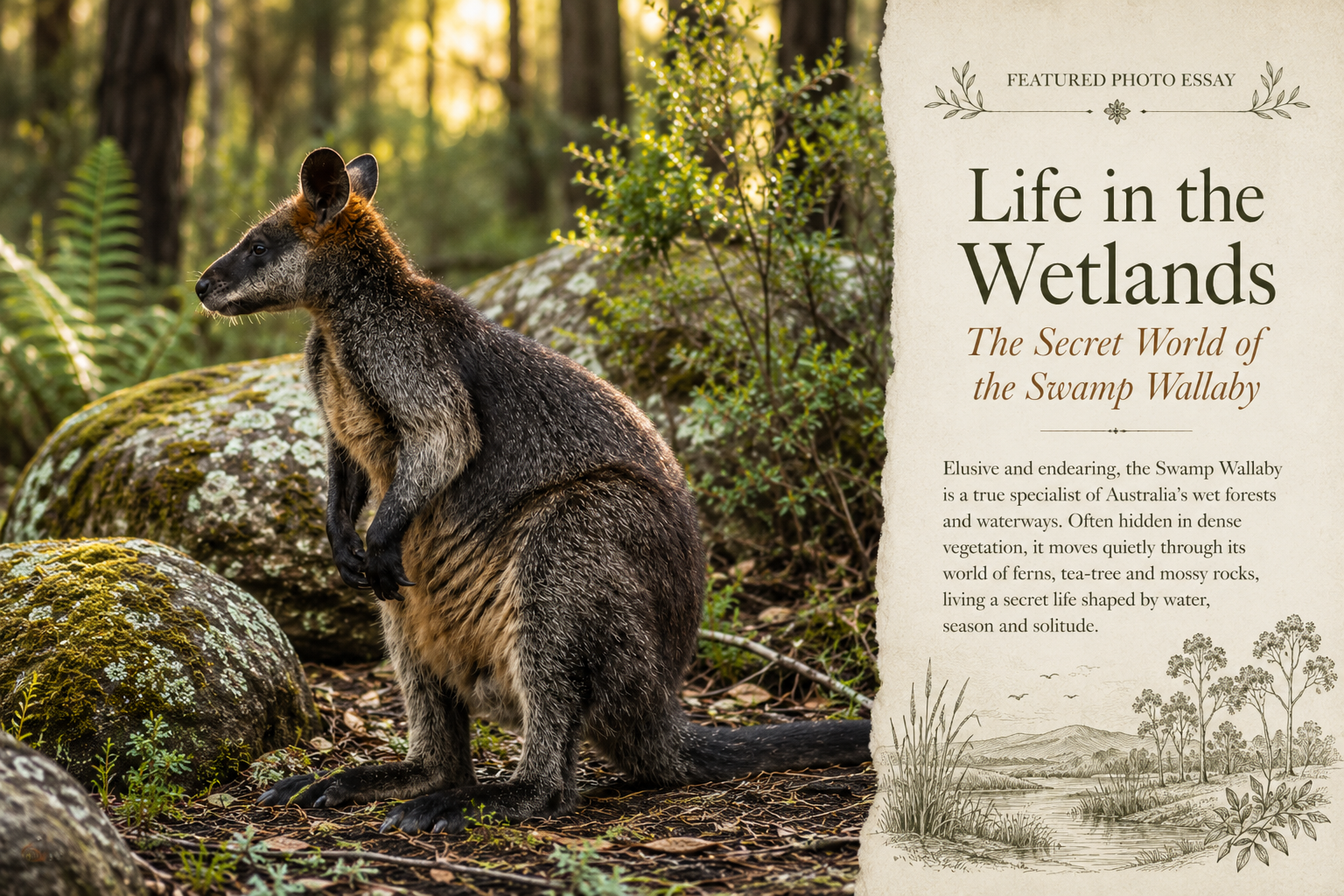
There are moments in the Australian bush when the landscape seems almost empty. The birds have fallen silent, the breeze barely stirs the reeds, and the only sound is the gentle rustle of leaves beneath your boots. Then, almost without warning, a pair of dark eyes appears from the shadows. A Swamp Wallaby pauses, watches quietly, and for a few precious seconds, two worlds meet.

Among Australia’s many native mammals, few are as quietly captivating as the Swamp Wallaby (Wallabia bicolor). While kangaroos often steal the spotlight across open plains and grasslands, the Swamp Wallaby belongs to a different world—a world of dense undergrowth, damp gullies, fern-filled forests, and secluded wetlands where patience is rewarded with unforgettable encounters. Shy by nature and perfectly adapted to life among thick vegetation, the Swamp Wallaby is often heard before it is seen. A soft rustle in the reeds, the snap of a twig, or a fleeting glimpse of movement disappearing into the scrub is often the only indication that one has been nearby. Yet for those willing to slow their pace and quietly observe, these gentle marsupials reveal themselves as one of Australia’s most fascinating woodland residents.
A Creature of the Understory
Unlike Eastern Grey Kangaroos that favour open country, Swamp Wallabies seek shelter beneath the forest canopy.Their preferred habitat includes: Wet sclerophyll forests, Dense eucalyptus woodland, Rainforest edges, Swamp margins, Creek lines, Tea-tree thickets, Heathland and Fern-filled gullies.
These environments provide not only protection from predators but also an abundance of food throughout the year. Dense vegetation allows the wallaby to remain almost invisible, relying on camouflage and stillness rather than speed to avoid danger. It is a master of disappearing into the bush.
Built for Life in Thick Vegetation
The Swamp Wallaby has evolved differently from many of Australia’s larger macropods.Its compact body, relatively short stature, and long, powerful hind legs allow it to move effortlessly through dense scrub where larger kangaroos would struggle. Its coarse, shaggy coat varies from dark grey to chocolate brown, often with rusty tones around the shoulders and chest. A lighter underside contrasts beautifully with its darker back, while the face carries a gentle expression framed by large ears that constantly rotate to detect the slightest sound. Perhaps its most distinctive feature is its long tail, carried low behind the body as it moves through the undergrowth. Every part of the animal seems designed for quiet survival.
The Quiet Rhythm of the Day
Swamp Wallabies spend much of the day resting beneath thick vegetation where the forest offers cool shade and protection. As afternoon fades into evening, they become increasingly active. They emerge cautiously from their shelter to browse on leaves, grasses, ferns, shrubs, fungi, bark, and new shoots. Unlike grazers that feed mainly on grass, Swamp Wallabies are browsers, selecting a remarkably varied diet that changes with the seasons. Watching one feed is surprisingly peaceful. It moves slowly, stopping often to sniff the air before taking another few careful bites. Every movement appears deliberate.
Solitary but Never Lonely
Unlike kangaroos that gather in large mobs, Swamp Wallabies are usually solitary animals. Adults spend much of their lives alone, coming together only during breeding. This solitary lifestyle helps reduce competition for food within dense habitats where vegetation may be scattered and visibility is limited. Although you may only see one at a time, several individuals often occupy the same forest, quietly sharing the landscape without ever forming obvious groups.

A Mother’s Journey
One of the most remarkable aspects of the Swamp Wallaby is its reproductive biology. Females are capable of raising one joey while simultaneously carrying another developing embryo—a rare reproductive strategy known as embryonic diapause. This allows breeding to continue efficiently, ensuring that when one joey leaves the pouch, another can continue developing. A tiny newborn, no larger than a jellybean, instinctively crawls into its mother’s pouch where it continues to grow for many months. Even after leaving the pouch, the young wallaby remains close to its mother, often diving back into the pouch whenever danger threatens. Few sights in the Australian bush are more heartwarming than a curious joey peering cautiously from its mother’s pouch.
Photographing Swamp Wallabies
Photographing Swamp Wallabies requires a different approach from photographing birds. Rather than searching open spaces, look into the edges of the bush.
Visit Early or Late
The first and last hours of daylight are when Swamp Wallabies are most active. Soft golden light also produces beautiful photographs.
Stay Quiet
Walk slowly. Pause often. Listen more than you look. Many encounters happen because the wallaby notices you first but chooses not to flee.
Focus on the Environment
Include surrounding ferns, reeds, fallen logs, or towering gum trees in your composition. These environmental portraits tell the story of where the wallaby lives.
Watch the Eyes
As with all wildlife photography, sharp eyes create connection. When a wallaby pauses to study you, there is often a brief moment of mutual curiosity that makes for a truly memorable image.
Living Alongside People
Swamp Wallabies have adapted surprisingly well to landscapes altered by humans.They are regularly seen along bushwalking tracks, nature reserves, rural properties, and even on the outskirts of suburban areas where patches of native vegetation remain. However, this close relationship also presents challenges. Vehicle collisions are one of the greatest threats to wallabies, particularly around dawn and dusk when they are most active. Domestic dogs can also pose significant risks in areas bordering bushland. Protecting native habitat corridors allows these animals to move safely between feeding and sheltering areas.
Their Role in the Ecosystem
Every native animal plays an important role within its environment, and the Swamp Wallaby is no exception. As browsers, they help shape the structure of forest undergrowth by feeding selectively on vegetation. Their movement through the bush disperses seeds and creates pathways used by smaller wildlife. In turn, they form part of a healthy food web that supports Australia’s unique ecosystems. A healthy population of wallabies often reflects a healthy forest.
A Moment to Remember
One cool autumn morning I paused beside a narrow creek lined with tea trees and bracken ferns. The forest was quiet except for the distant call of a Grey Shrike-thrush. Movement caught my eye. Standing partly hidden among the reeds was a Swamp Wallaby. It wasn’t feeding. It simply watched. For nearly a minute we remained perfectly still, separated by only a few metres yet sharing the same peaceful silence. The early sunlight filtered through the gums, catching the fine edges of its fur while tiny droplets of dew sparkled on the grasses around it. Eventually it lowered its head, took one final look, and slipped soundlessly back into the forest. Within seconds it had vanished completely. Only the gently swaying reeds hinted that it had ever been there. Moments like these cannot be planned. They are gifts from nature, offered only to those willing to slow down.
Final Reflections
The Swamp Wallaby reminds us that Australia’s forests are filled with quiet wonders waiting to be discovered. It is not an animal of dramatic displays or noisy gatherings. Instead, it represents the calm rhythm of the bush itself—patient, watchful, and deeply connected to the landscapes it calls home. Every encounter feels personal because it is earned through stillness rather than pursuit. Perhaps that is why so many bushwalkers remember their first Swamp Wallaby long after the details of the trail have faded. It is not simply the animal they recall, but the feeling of being welcomed, however briefly, into its hidden world. The next time you walk beside a fern-filled creek or through a damp eucalyptus forest, slow your pace and look into the shadows. You may discover that the bush has been quietly watching you all along.
“Some of Australia’s greatest wildlife encounters happen not in the open, but in the quiet spaces between the trees.”