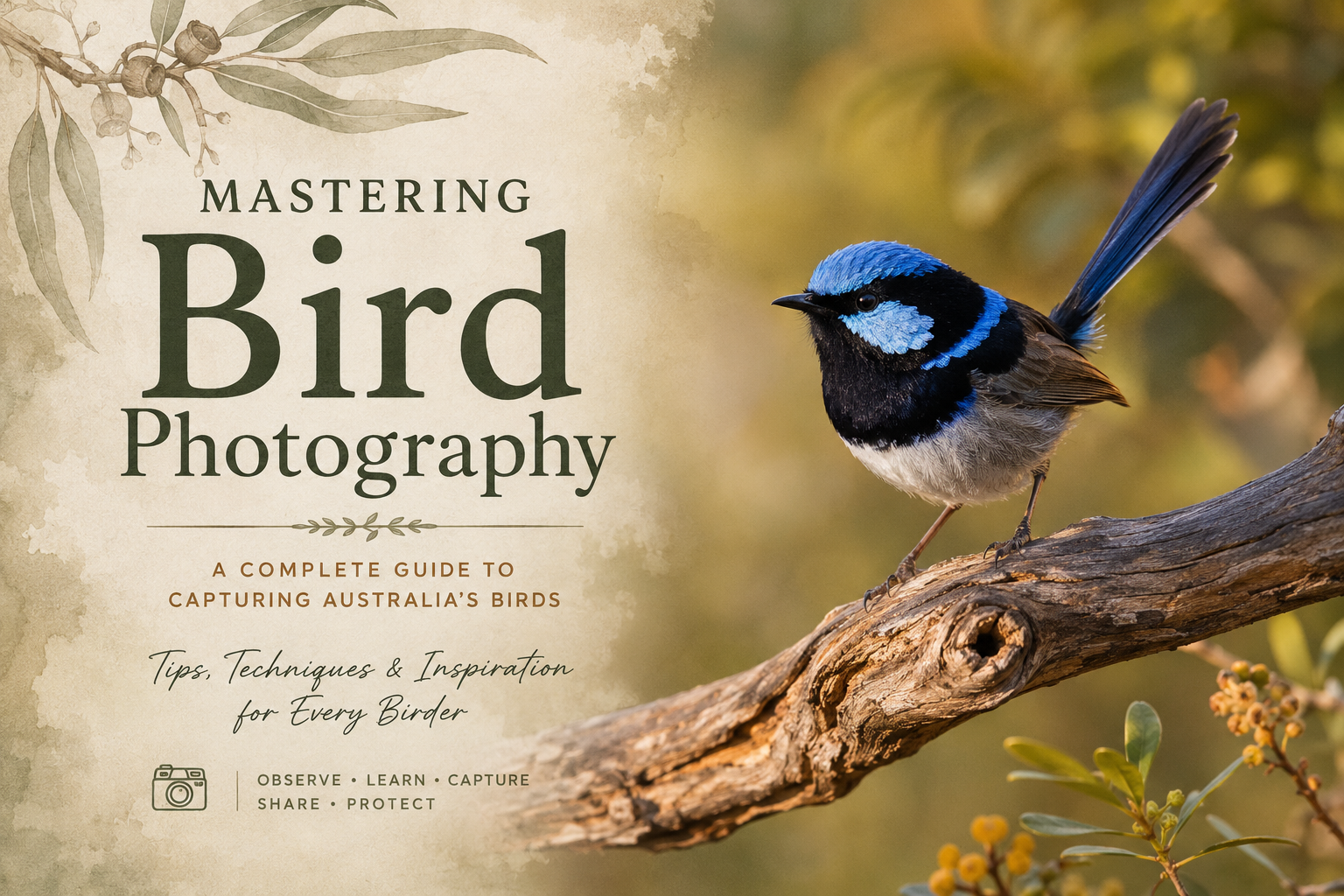
Mastering Bird Photography: A Complete Guide to Capturing Australia’s Birds
Bird photography is one of the most rewarding forms of wildlife photography. Every outing offers something different—a flash of brilliant colour through the trees, a majestic bird of prey soaring overhead, or the quiet beauty of a tiny fairywren hopping through the undergrowth. Unlike many other photography subjects, birds rarely pose for long. They move quickly, change direction without warning, and often disappear just as you’ve found them.
That challenge is exactly what makes bird photography so addictive.
The perfect photograph isn’t always the one with the rarest bird or the biggest zoom lens. Instead, it’s the image that captures behaviour, emotion, light, and habitat while respecting the welfare of the bird. Whether you’re using a professional camera with a long telephoto lens or simply photographing birds with your phone during a morning walk, the principles remain the same.
Start by Observing
Before lifting your camera, spend time watching.
Many photographers begin shooting the moment they spot a bird. Instead, pause and observe.
- Where is the bird feeding?
- Is it hunting insects?
- Is it returning to the same perch?
- Is it alert or relaxed?
- What direction is it moving?
Birds often follow predictable patterns. A Willie Wagtail may return to the same fence post after catching insects. A Sacred Kingfisher may repeatedly dive from one branch. By learning these routines, you’ll be ready before the action happens.
The best wildlife photographers are often the best wildlife observers.
Learn Bird Behaviour
Understanding behaviour dramatically improves your success.
Different species behave differently.
Small insect-eating birds rarely stay still for long, while herons can stand motionless for several minutes. Honeyeaters constantly move between flowering trees, whereas cockatoos often feed together in noisy flocks.
Seasonal behaviour also changes throughout the year.
During spring, birds are more vocal, territorial, and busy collecting nesting material. In autumn and winter, food sources shift, bringing birds into different habitats.
The more you know about your subject, the more successful your photographs will become.
The Importance of Light
Photography literally means “drawing with light.”
The quality of light determines how your image feels.
Golden Hour
The hour after sunrise and the hour before sunset provide soft, warm light that flatters feathers and creates gentle shadows.
Colours appear richer, reflections are softer, and backgrounds become beautifully blurred.
Overcast Days
Cloudy conditions act like a giant softbox.
Feather detail becomes easier to capture, bright white birds avoid harsh highlights, and exposure is more forgiving.
Midday Sun
Bright overhead sunlight can create harsh shadows under wings and around the eyes.
If photographing in the middle of the day:
- Look for birds in open shade.
- Position yourself so the sun is behind you.
- Slightly reduce exposure to preserve white feathers.
Focus on the Eyes
If there’s one rule every wildlife photographer follows, it’s this:
Sharp eyes create powerful photographs.
Our eyes naturally connect with the eyes of animals.
Even if the tips of the wings are slightly soft, a sharply focused eye gives the image life.
Use continuous autofocus for moving birds, and when possible, select a single focus point positioned directly over the bird’s eye.
Choose a Clean Background
Busy backgrounds distract from your subject.
Before pressing the shutter, quickly scan what’s behind the bird.
Look for:
- Soft green foliage
- Distant trees
- Blue sky
- Calm water
- Natural bokeh
Avoid:
- Cars
- Buildings
- Bright signs
- Power lines
- Cluttered branches
Sometimes moving just one or two steps to either side completely transforms the composition.
Fill the Frame—But Don’t Forget the Habitat
Portraits are wonderful, but environmental photographs often tell a richer story.
A tiny fairywren surrounded by native grasses says more about its life than a tightly cropped portrait alone.
Try photographing birds in several ways:
- Close-up portraits
- Birds in flight
- Feeding behaviour
- Family groups
- Birds interacting
- Birds within their landscape
Variety keeps both your photography and your field journal interesting.
Composition Tips
Good composition guides the viewer’s eye naturally through the image.
Some useful techniques include:
Rule of Thirds
Position the bird slightly off-centre to create balance and space.
Leave Room to Look
If the bird is looking or flying in one direction, leave space in front of it rather than behind it.
This creates a sense of movement.
Watch the Horizon
Keep horizons level, especially around wetlands and lakes.
Simplify
Remove distractions by changing your angle, zooming in, or waiting for the bird to move into a cleaner position.
Camera Settings
You don’t need the most expensive equipment, but understanding your settings helps.
Shutter Speed
Birds move quickly.
As a guide:
- Perched birds: 1/500 second
- Small active birds: 1/1000 second
- Birds in flight: 1/2000 second or faster
Aperture
A wide aperture (such as f/4 to f/6.3) helps blur the background and isolate your subject.
For groups of birds, use a narrower aperture to keep more of the scene in focus.
ISO
Increase ISO when necessary rather than accepting motion blur.
Modern cameras handle higher ISO surprisingly well.
A slightly noisy image is usually better than a blurry one.
Photographing Birds in Flight
Birds in flight can be challenging but incredibly rewarding.
Success comes from practice.
Tips include:
- Track the bird smoothly before taking the shot.
- Keep both eyes open when following large birds.
- Use continuous autofocus.
- Shoot in burst mode.
- Start following the bird early rather than reacting at the last second.
Large soaring birds are excellent subjects for practising before attempting fast swallows or fairy martins.
Getting Closer Without Disturbing Birds
The secret isn’t always a longer lens.
It’s patience.
Move slowly.
Avoid sudden movements.
Wear muted colours.
Use trees, shrubs, or rocks as natural cover.
If you remain still, many birds will continue their normal behaviour, often approaching surprisingly close.
Respect Wildlife
Ethical bird photography should always come first.
Never:
- Disturb nests.
- Move chicks for a better photograph.
- Play bird calls excessively to attract species.
- Chase birds repeatedly.
- Damage vegetation for a clearer view.
A photograph is never worth causing stress to wildlife.
Leave every location exactly as you found it.
Bird Photography With a Smartphone
Modern smartphones are surprisingly capable.
To improve your results:
- Clean the lens.
- Tap on the bird’s eye to focus.
- Hold the phone with both hands.
- Use burst mode for movement.
- Move closer instead of relying on digital zoom.
- Photograph birds in good light.
Phones excel at habitat images, larger birds, and storytelling photographs.
Build a Field Journal
Photography captures what you saw.
A journal captures what you experienced.
After each outing, record:
- Location
- Date
- Weather
- Time of day
- Camera and lens
- Species observed
- Interesting behaviours
- Favourite photographs
- Lessons learned
- Habitat conditions
Over time, your journal becomes an invaluable record of both your birding adventures and your growth as a photographer.
Common Mistakes to Avoid
Even experienced photographers make mistakes. Being aware of them can save frustration in the field.
- Chasing birds instead of waiting for opportunities.
- Cutting off wings or tails with tight framing.
- Ignoring distracting backgrounds.
- Shooting only at eye level—try kneeling or lying down for a more natural perspective.
- Forgetting to check your camera settings after moving between different lighting conditions.
- Oversharpening or overediting images in post-processing.
- Spending the entire outing looking through the viewfinder instead of enjoying nature.
Remember, not every outing will produce award-winning photographs. Some days you’ll return with only a handful of images, but you’ll gain valuable experience that improves every future trip.
Final Thoughts
Bird photography is about far more than creating beautiful images. It teaches patience, observation, respect for wildlife, and a deeper connection with the natural world. Every sunrise spent in the bush, every quiet hour beside a wetland, and every unexpected encounter adds to your understanding of Australia’s remarkable birdlife.
Some of your favourite photographs may not be technically perfect. They may have soft light, a windswept feather, or a bird partly hidden among the leaves. Yet those are often the images that carry the strongest memories, reminding you not just of what you saw, but of how it felt to be there.
Take your camera, slow your pace, and let nature reveal its stories—one bird, one moment, and one photograph at a time.
