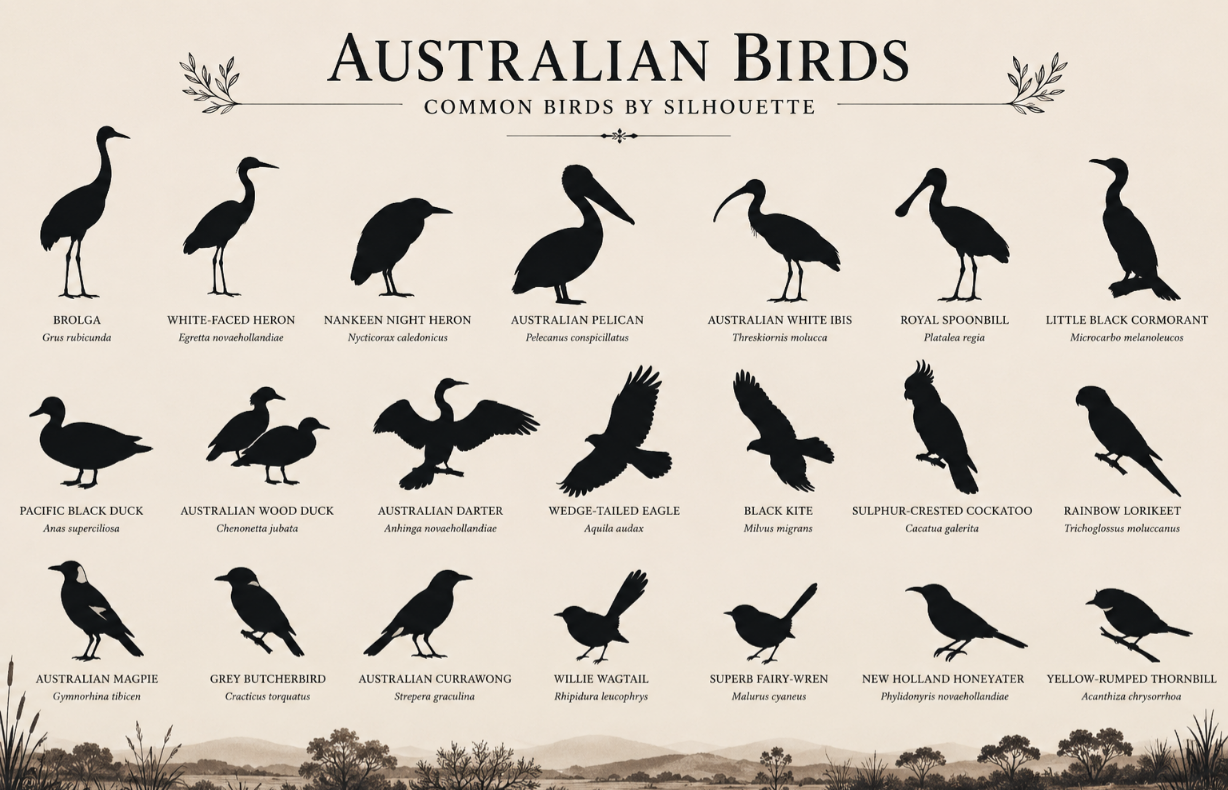
When colour fades in the early morning light or a bird passes high overhead, its silhouette often tells you more than its feathers ever could. One of the most valuable skills a birder can develop is learning to identify birds by their shape alone. Long before binoculars reveal the finer details of plumage, your brain can begin narrowing down the possibilities simply by recognising a bird’s outline.
Experienced birders often know what they’re looking at before the bird lands. They notice the long neck of a heron gliding across a wetland, the unmistakable silhouette of a cockatoo flying overhead, or the graceful wings of a kite circling on rising thermals. It’s a skill that develops with practice, and once you begin looking at birds this way, you’ll find identification becomes faster, easier, and far more rewarding.
Why Silhouette Matters
Birds are not always seen in perfect conditions. They may be backlit by the rising sun, hidden among branches, or flying too high to reveal their colours. In these moments, shape becomes your greatest clue. A bird’s silhouette tells you about its lifestyle. Long legs suggest a wader. Broad wings hint at a soaring raptor. A short, rounded body with a tiny bill may point to a pigeon or dove. Even before colour comes into play, the overall form of a bird reveals its place in the landscape.
Start with the Overall Shape
Rather than focusing on small details, ask yourself a few simple questions.
Is the bird large or small?
Does it have a long neck?
Are the legs long or short?
Is the tail long, forked, rounded, or square?
Is the bill short, hooked, straight, or curved? How are the wings shaped?
The overall silhouette is often more useful than individual markings.
Look at the Neck
The neck is one of the easiest features to recognise.
Long Necks
Species such as herons, egrets, ibis, and cranes have long, elegant necks. In flight, herons tuck their neck into an “S” shape, while cranes and ibis stretch theirs straight out in front. This single feature can quickly separate similar-looking birds.
Short Necks
Parrots, cockatoos, pigeons, honeyeaters, and most woodland birds have short necks that blend smoothly into the body.
Pay Attention to the Bill
Even from a distance, the shape of the bill provides important clues.
Long spear-shaped bill – Herons, egrets, kingfishers.
Curved bill – Curlews, ibis, honeyeaters.
Hooked bill – Eagles, hawks, falcons, owls.
Short stout bill – Finches, parrots.
Fine pointed bill – Wrens, robins, thornbills.
When the bird is backlit, the bill often stands out clearly against the sky.
Wings Tell a Story
Wing shape is closely linked to the way a bird flies. Broad Wings
Large soaring birds such as eagles, kites, and wedge-tailed eagles have broad wings with finger-like feathers spread at the tips. These birds glide effortlessly with very little wing movement.
Long Narrow Wings
Swifts, swallows, and terns have slender wings designed for speed and agility.Their flight is fast, graceful, and constantly changing direction.
Rounded Wings
Forest birds like pigeons, parrots, and many songbirds have rounded wings suited to quick take-offs and weaving through trees. Their wingbeats are usually rapid and energetic.
Study the Tail
Tail shape is another useful clue.
Forked tail – Swallows, martins, kites.
Long pointed tail – Magpies, cuckoos.
Square tail – Ravens, crows.
Rounded tail – Many parrots and pigeons.
Very long tail – Lyrebirds, pheasant coucals, rosellas. A tail can be just as distinctive as a bird’s colours.
Don’t Forget the Legs
Legs often reveal where a bird lives. Long-legged birds usually feed in shallow water. Examples include: Herons, Egrets, Spoonbills, Stilts, Brolgas
Short-legged birds are more likely to perch, climb, or feed in shrubs and trees.
Watch the Flight Pattern
Sometimes it’s not the shape but the movement that identifies the bird.
Raptors
Circle effortlessly on thermals.
Cockatoos
Steady wingbeats with little gliding.
Magpies
Deep, relaxed wingbeats.
Willie Wagtails
Quick changes of direction with constant tail movement.
Swallows
Fast, twisting flight while catching insects.
Pelicans
Slow, powerful wingbeats followed by long glides.
Every species has its own rhythm.
Learn the Bird Families
Rather than memorising hundreds of species, begin by recognising families. Ask yourself: Is it a duck? A raptor? A parrot? A honeyeater? A heron? A pigeon? A cuckoo?
Once you know the family, identifying the exact species becomes much easier.
Practice at Dawn and Dusk
The best time to develop silhouette skills is during the golden hours of the day. When birds appear as dark outlines against the morning or evening sky, colour becomes less important and shape becomes everything. You’ll soon find yourself recognising familiar species long before your binoculars reach your eyes.
Common Australian Silhouettes

Some birds have outlines that become instantly recognisable with experience.
Laughing Kookaburra– Large head, heavy bill, chunky body, broad tail.
Australian Pelican – Enormous bill, long neck, huge wings.
Nankeen Night Heron – Compact body, thick neck, broad wings, tucked posture.
White-faced Heron – Slender neck, long legs, spear-like bill.
Sulphur-crested Cockatoo – Rounded wings, stocky body, broad tail and prominent crest.
Superb Fairywren – Tiny body, upright posture and long tail usually held high.
Australian Magpie – Long legs, pointed bill and confident, level flight.
Wedge-tailed Eagle – Massive wings with a distinctive wedge-shaped tail.
Build Your Birding Eye
Improving your silhouette recognition takes time, but every outing helps.When you see a bird, challenge yourself to identify it before reaching for your binoculars. Study its outline, posture, and movement. Once you’ve made your guess, confirm it using your field guide or binoculars. Over time, you’ll rely less on colour and more on shape, behaviour, and habitat—the same way experienced birders do.
Final Thoughts
The beauty of birding lies in learning to notice what others often overlook. A fleeting shadow crossing the sky, a silhouette perched on a distant branch, or the unmistakable outline of a heron lifting from a misty wetland can become as familiar as an old friend. The next time you’re outdoors, resist the urge to look for colour first. Instead, look for shape. You may be surprised how much a simple silhouette can reveal.
“Every bird has its own signature. Learn its silhouette, and you’ll begin to recognise it long before the colours come into view.”