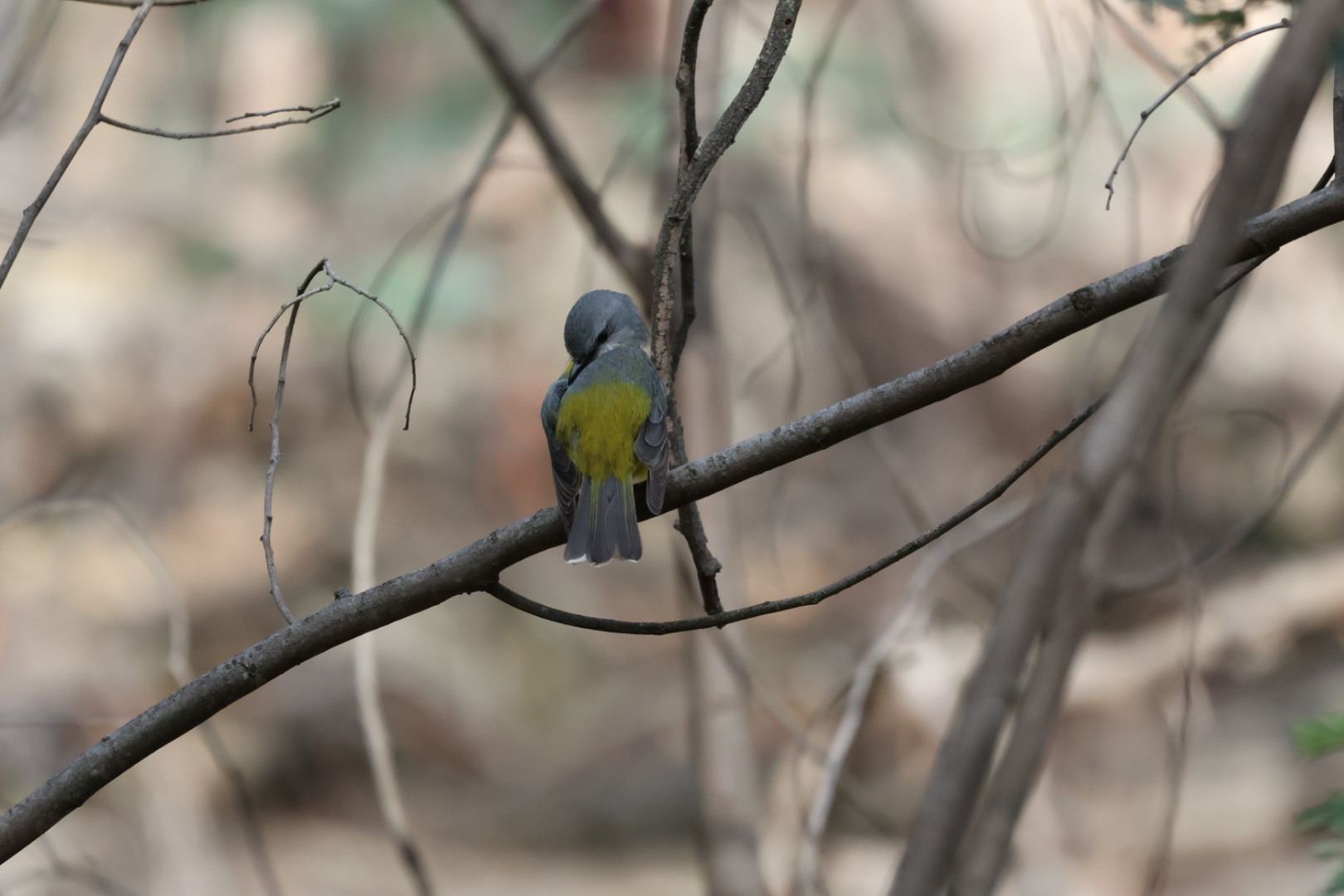
Photographing the Eastern Yellow Robin in Kara Kara
A small bird, a soft light, and the patience to meet it halfway. Kara Kara National Park is a place built from shadows — ironbark trunks, dry leaf litter, the muted greens of box woodland. It’s not a landscape that gives up its subjects easily. Everything blends, everything hides.
And then the Eastern Yellow Robin appears, bright as a dropped petal against the bark. For a photographer, it’s the perfect contradiction: a vivid bird in a subdued forest, but one that refuses to sit in the open for long. This guide is about learning the rhythm of the robin, and letting the forest slow you down enough to see it properly.
1. Know the bird’s habits
The yellow robin is a perch‑and‑pounce hunter. That’s your advantage. It will: sit low on the shaded side of a trunk, watch the ground with absolute stillness, drop straight down to the leaf litter and return to the same perch. This means you’re not chasing a bird — you’re learning a loop. Once you find the perch, you’ve found the photograph.
2. The robins favour
The edges of clearings, leaning ironbark trunks, fallen logs and quiet gullies where the light comes in sideways. They avoid the harsh, open patches. They like the places where the forest feels like it’s holding its breath. If you walk slowly — slower than feels reasonable — they appear. Often closer than you expect.

3. Camera settings that suit the forest
Kara Kara’s light is soft but inconsistent. The ironbarks create deep shade, and the robins love those shadows. A reliable starting point:
Shutter: 1/800–1/1250 (they flick between perches quickly)
Aperture: f/4–f/5.6 (enough depth for the bird + trunk)
ISO: 800–2000 depending on shade
Focus mode: Continuous AF with a small zone
Drive: High‑speed burst, but use it sparingly — the robin often gives you a still moment.
If your camera struggles in low light, lean into the mood. Noise suits this forest more than over‑sharpening ever will.
4. Light: the real subject
The best robin photographs here aren’t about the bird. They’re about the way the yellow holds the light. Look for: early morning when the forest is blue‑grey, late afternoon when the trunks warm to red, overcast days when the yellow glows without glare. Avoid midday. The contrast flattens the bird and kills the subtlety of the scene.
5. Composition: let the forest speak
The robin is small. The forest is everything. Try: placing the bird low in the frame, anchored by a trunk, using the ironbark’s vertical lines as structure, leaving negative space where the bird is watching, capturing the moment before the pounce, when the whole body tightens. The best images feel like a conversation between bird and landscape, not a portrait extracted from it.
6. Fieldcraft: how to move
The robin responds to behaviour more than distance.
Do: walk slowly, stop often, stand still longer than feels necessary, keep your breathing soft and let the bird decide the distance.
Don’t: track it too closely, move directly toward it but don’t break the rhythm of the forest. If you behave like part of the scenery, the robin accepts you.
7. Gear that helps (but doesn’t matter as much as patience)
A 300–400mm lens is ideal. A 70–200mm works if you’re willing to let the environment dominate the frame.
A monopod can help in the deep shade, but isn’t essential.
The real tool is stillness.
8. The moment you’re waiting for
There’s a point — just before the robin drops to the ground — when it becomes completely focused. Head angled. Body taut. The forest goes quiet around it. That’s the photograph. Not the jump. Not the landing. The breath before movement.
Kara Kara teaches you to see that moment.
The robin rewards you for noticing.